Interview with Quiet Rebels’ writers and directors
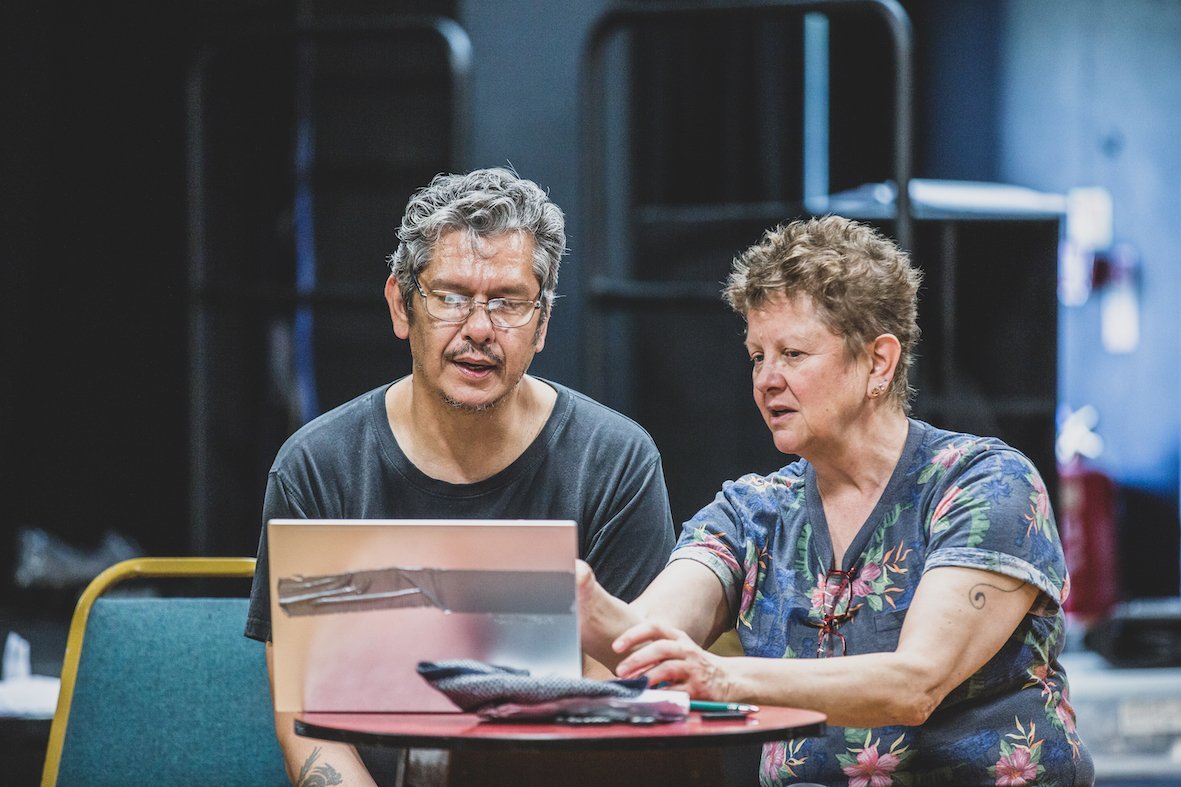
Hassan Mahamdallie and Julie McNamara, Writers and Directors of Quiet Rebels, talked about the stories behind the play in an interview with Colin Hambrook, Editor at Disability Arts Online. The interview was initially published on Disability Arts Online in September 2022.
How did you come together to create this project?
Julie McNamara (JMc): Two significant producers and advisers in the creative industries raised Hassan’s name: ‘You should work with Hassan Mahamdallie.’ Then I heard Hassan speak with great passion about his vision of a creative case for diversity. It was crystal clear, convincing and he began his presentation with a beautiful poem by Langston Hughes – Harlem: A Dream Deferred.
I wrote to Hassan afterwards and thanked him, then I went to see his show. That was the beginning.
Hassan Mahamdallie: In 2016 Julie came to see my play The Crows Plucked Your Sinews (about the British colonisation of Somalia and the lives of British Somalis today). We had a chat, realised that although we each had our particular historic arenas of struggle, myself anti-racism, and Julie the struggle for disabled rights, we both shared a radical agenda around the working class, and writing for and about working class people and their supressed histories. We both share the conviction that those who really change the course of history are those most ignored and forgotten.
So we agreed that we should collaborate on a play at some point in the future. I thought it would be exciting to work with Julie and Vital Xposure, and to learn from her and the company about the politics and aesthetics of disability in theatre. But we didn’t have an idea – a subject area to explore. And then sometime later, the whole Windrush ‘hostile environment’ scandal blew up – which for me was an attempt by the Tories to forcibly erase that whole post World War Two generation of our elders and their contribution.
At the same time, I came across a biographical article from the renowned educationalist Professor Heidi Safia Mirza, whose father, like my own, was an Indian from Trinidad, and whose mother was a white European, like my mother. In the article Mirza wrote that: “white women, like my mother, who married black men – those so-called ‘dark strangers’ – are the silent heroes of this generation. They were true pioneers, those who crossed over in another way. They too have a story to tell of racism and transcendence, of love and care for their dark-skinned children… Their story of mothering work to shape a new generation of ‘dual heritage’ children is one that is largely forgotten in the post-colonial story of diaspora and displacement”.
I thought that was a really interesting way of looking at the history of the Windrush generation – through the lens of these white working class women who fell in love with these ‘dark strangers’ and in their own way altered history, and shaped the multicultural society we enjoy today. I told Julie that I thought I had something we could both write about. What I didn’t know at the time, was that Julie and her family was in the middle of their own fight against racism and the state.
JMc: For me, researching these stories and writing this play, was vital to my mental health. I have been seething with rage at the devastating impact of successive governments’ casual disregard of the contribution of black people and other communities of colour in shaping the country we live in today. My nephew Troy has been in this country since he was 18 years of age. He’s been at the heart of our family for 21 years and together with my niece Sophie, they are raising four beautiful, creative, passionate political souls as part of our family. It has taken us five years in an excruciating legal process to fight against Troy’s deportation. In October 2020, in the middle of lockdown no 3, justice was finally done in the Royal Courts of Justice, or for us, in a hideous experience on a Zoom tomb in a laptop screen in Liverpool!
I am still seething, at the emotional, mental and financial impact of those five years of institutional racism that meant we were obliged to prove in four hearings in court that Sophie and Troy are in ‘an enduring relationship’ and that it would indeed be ‘unduly harsh’ on the four children to have their father removed to Jamaica. WTAF!?
How did you go about researching Quiet Rebels?
HM: We set about looking for working class women that we could interview who had married across ‘the colour line’ from the period of the end of World War Two up until the 1970s. Their voices had to be at the heart of our play.
This generation are now in their seventies and eighties, and we realised that their testimonies were in danger of being lost forever. The final script is built around interviews with four women we interviewed – from Yorkshire, Liverpool, West Midlands and London. Tragically, two of them have died since we conducted the interviews, including my own mother.
We decided to concentrate on women’s voices, but we know there were also working class white men who married women of colour who came to the UK to work during the post war period.
But the white women in those mixed relationships faced particular hostility that their white male equivalents, on the whole, didn’t experience. The women were widely regarded as race traitors, sexually deviant and punished for ‘going’ with men of colour. My mother was ostracised by her parents for decades, shunned by her closest neighbours, and regularly spat at and called an N-lover for the ‘crime’ of walking in the street with her husband or her ‘half-caste’ children.
Maybe it is difficult today to comprehend the barbaric level of hostility that mixed couples faced back then. But when was born in 1961, surveys showed that around nine out of ten people were totally against marriages between white women and black men.
By 1986 that number had gone down to 50%, and now stands at 15% of the population.
But that gradual turn-around didn’t happen by itself – it’s because people down the years refused to concede to bigoted attitudes and fought against racism. Part of our motive for staging the play was to show how crucial those ‘silent heroes’ as Mirza puts it, are to laying the foundations for the modern multicultural society we perhaps too easily take for granted.
The stories we collected were fascinating in all sorts of ways. Firstly the variety of backgrounds of the women – from rural backgrounds, from poor working class, manual backgrounds, and what you might call white collar families. They all met their partners in different ways – at a Saturday night dance, a chance encounter in a lunch café, at a night out in an Indian restaurant.
JMc: I started with my niece’s story. And in the first R&D we presented at the Albany, south London, we used the actual court transcripts and the judgement in the Upper Tier Supreme Court in London. The language used then and now, clearly depicts the deeply ingrained racism we have been raised with in this country. It seeps through every structure in our society, starts with royalty and is woven into the fabric of our class-ridden society.
I went on to interview friends from the travelling community whose parents were known as ‘Scots Marie and the Black Gypsy’, perhaps their story deserves a play of its own. I chose people from Liverpool because the city is built on slavery and has one of the largest and longest established Black British communities in the country.
I chose a colleague who has a mixed heritage family and who has lived in five countries and still describes England as ‘the most racist country I ever had the misfortune to live in’. The women I interviewed are ordinary working class women who have fought hard throughout their lives to hold onto what they believe in, with extraordinary fortitude and unexpected defiance. When Hassan and I sat together with the stories we had gathered, there was a common thread underlying the spirit of these women. These are our ‘quiet rebels’.
How did you create a framework for feeding those stories into the narrative of Quiet Rebels?
HM: The initial R&D for the project was started pre-COVID, and then we were plunged into the lockdown. At the time both me and Julie, like a lot of people, were binging on Netflix. We realised we liked the same kind of stuff – particularly detective stories and film noir and sci-fi and dystopias.
We decided to write the play as a dystopia, set in the near future in a disintegrating post-Brexit England, in the grip of a racist authoritarian regime where black and brown immigrants have been expelled, and where mixed relationships are illegal. And make the central protagonist a detective attached to the regime, ordered to solve a murder of a elderly white woman who had been branded a race traitor, and as a result had lost her children.
For the next stage of R&D we wrote some key scenes and then rehearsed and recording the actors over zoom sitting in their bedrooms. We asked Mohammed Ali from Soul City Arts to construct a digital sci-fi backdrop to each scene, edited it all together, and then had an online showing for some of our theatre friends. And people really loved what we had done by placing the women’s’ stories in this imaginative framework.
What was the reason for staging the play in 2028?
JMc: Playing with sci-fi, inventing a world with the smoke and mirrors of our imagined future, gives us plenty of room to rattle our audiences’ imagination and say to them: ‘Yes, we did say 2028, but look around, we already have Race Detention Centres, look to your left, we’ve already built Testing Centres where we send Disabled people, anyone on income support, for ‘Work Capability assessments’. We use evidence from history, accurate dates and historical facts, and then we throw in a curved ball. So we write as if this is Enoch Powell’s legacy. This is the racist future he had dreamed up.
HM: All the elements of our dystopia – extreme racism, intolerance and scapegoating, authoritarian “strong men”, efforts to reverse engineer this country (and other European states and the USA) back to some kind of mythical ethnically “pure” white, male-dominated society, where groups such as the poor, disabled and marginalised are erased through state policy, are all in motion now in 2022. And that process is accelerating.
To our dismay, we kept being confronted with aspects of our 2028 fictional dystopia appearing in the real world. The criminalisation of “race-mixing” is the starting point of the narrative of Quiet Rebels. In July, Victor Orban of Hungary makes a speech asserting that “we [Hungarians] are not a mixed race … and we do not want to become a mixed race,” and that countries where European and non-Europeans mingle were “no longer nations”.
Now the idea of forbidding “race mixing”, that we thought had been buried with Apartheid South Africa, is back out there in the European mainstream. We want to remind people that history and progress does not always go forward -sometimes very quickly it can be thrown back. We hope that our audiences will leave the theatre determined to make sure that the 2028 the play depicts never happens.
JMc: I can’t add to this except to point out the number of people who have witnessed the first versions of this work and come away feeling perturbed. And then they begin to question what has been happening recently and we have allowed it, because we are second guessing our own reality. This is what our Tory government want.
What are you aiming to do with the creative residencies for young people and online resources?
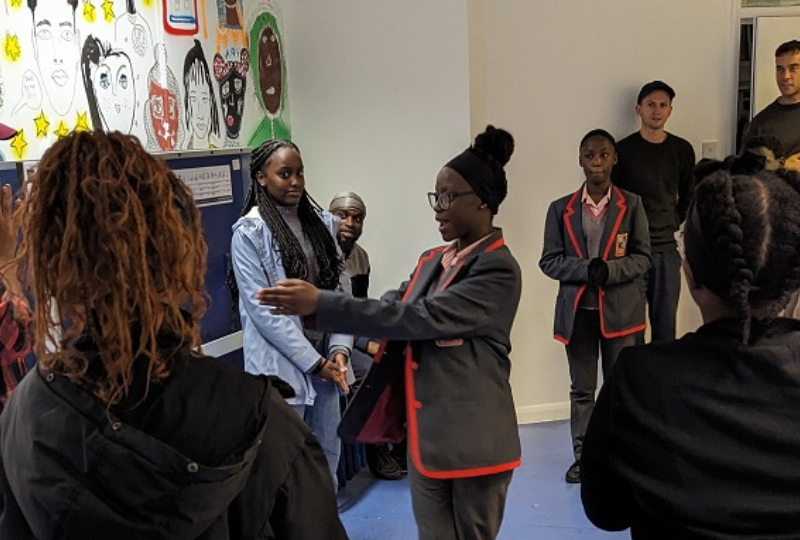
JMc: We are hoping to fill in a piece of missing history in young people’s education to date. Our education system is institutionally racist, filled with skewed histories from a White Supremacist perspective. And we all know that history is told by the winners, by the colonisers, by the imperialist upper classes. We are aiming to challenge those skewed stories with some of those stories from our Quiet Rebels, and have the young people go out and find out from their elders about their particular histories and struggles. That the multicultural society they are a part of today has not always existed. Past generations had to fight to establish it, and now this generation of young people in particular will have to defend it from those destructive forces who want to take us all backwards.